
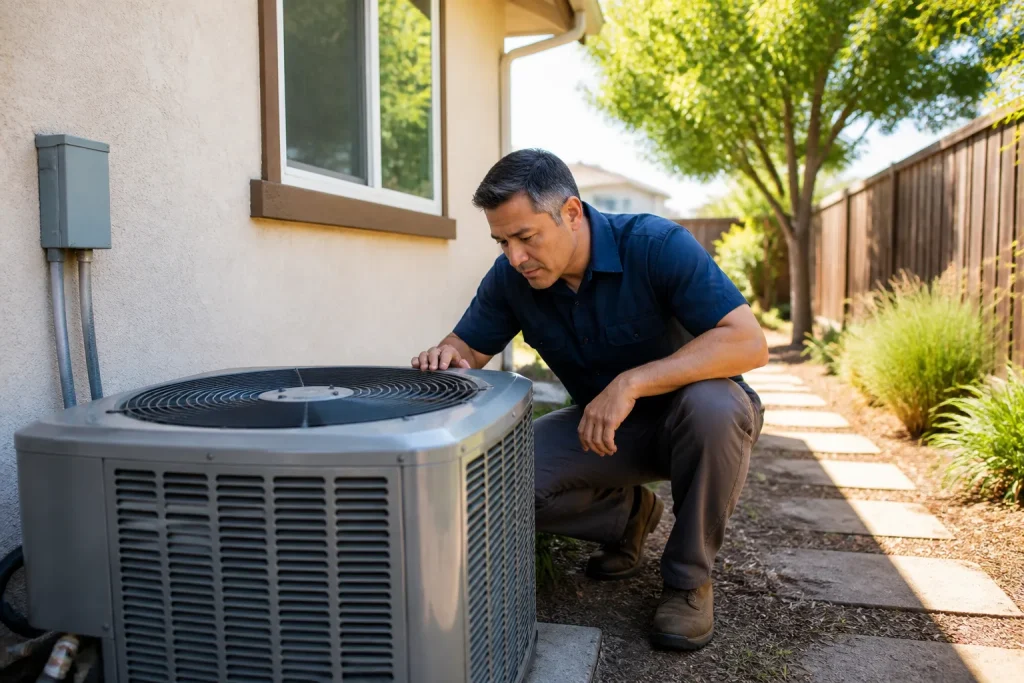
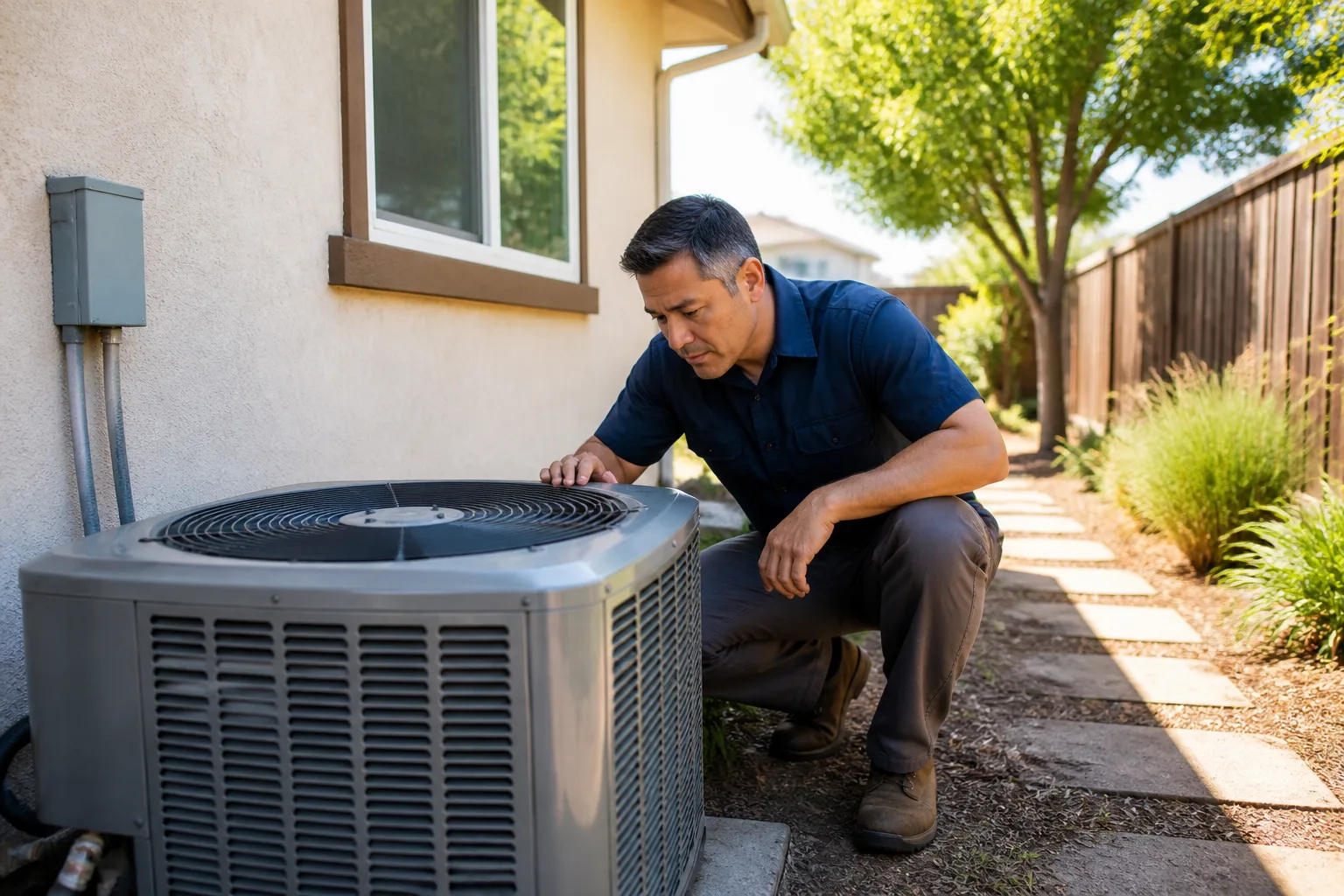
Emergency AC Repair Near Me: What Hayward Homeowners Should Do First
Turning your AC back on after it trips a breaker is one of the most expensive mistakes Hayward homeowners make. A tripped breaker is the system protecting itself, and overriding it can turn a $300 capacitor replacement into an $1,800 compressor job. The right move in the first few minutes is almost always a controlled shutdown, not another flip of the switch. If you’d rather hand it off to someone who does this every day, call (888) 870-1847. We answer 24/7, with fast dispatch from 7am to 7pm.
Why did your AC stop, and what should you do in the first 15 minutes?
Stop trying to restart it. That is the short answer, and it holds for more failures than people expect. When a central system shuts off hard – a breaker flips, the outdoor unit goes silent, the thermostat blanks out – something in the system decided it wasn’t safe to keep running. Every restart attempt pushes current through a part that may already be stressed. In our experience, the difference between a cheap fix and an expensive one usually comes down to what happens in that first window.
Here’s the shutdown protocol we walk homeowners through on the phone:
- If the breaker tripped, leave it off. Don’t reset it “just to see.” A breaker that flips once on a hot afternoon and stays put afterward is telling you something. A breaker that flips again immediately after reset is shouting it.
- If the outdoor unit is running but blowing warm air, shut it down at the thermostat first. Set it to off, then flip the AC disconnect or the breaker serving the condenser. A compressor running without proper cooling is the fastest way to destroy it.
- If you smell burning, hear grinding or see ice on the refrigerant lines, cut power at the breaker. Ice on the lines with the system off is fine. Ice with the system running means it’s starving for airflow or refrigerant, and running it makes the damage worse.
- Write down what happened before you touch anything else. What was the thermostat set to? Did the fan keep running while the outdoor unit stopped? Any error code on the display? That information is worth more to a technician than a dozen guesses.
If water is pooling anywhere near the indoor air handler, shut the system down and deal with the water first. Active water damage is a true emergency; a warm house in Hayward usually isn’t.
Is your AC problem a true emergency or can it wait until morning?
A true AC emergency in Hayward is a health risk or active water damage, not discomfort. That distinction matters because it determines whether you’re calling for fast dispatch or booking a slot for the next opening. Most no-cooling calls we handle are urgent but not dangerous – the house is warm, everyone is safe, and the fix happens the same day.
Treat it as a genuine emergency when:
- Someone in the home is elderly, very young, or has a health condition that heat makes worse, and indoor temperatures are climbing past what they can handle.
- You have active water damage – condensate overflowing from the air handler, a soaked ceiling, or water near electrical components.
- You smell burning, see smoke, or notice scorched wiring at the disconnect or panel.
- The system is short-cycling violently, tripping the main breaker, or making a noise you’d describe as “metal on metal.”
On the other side of the line: a system that’s blowing slightly warm, a thermostat that won’t hold a setpoint, or a unit that runs fine but takes forever to cool the house can usually be handled on the next dispatch. Call it in either way. We answer 24/7, and a call outside dispatch hours gets booked into the next opening, Sunday through Friday, 7am to 7pm. That’s the honest answer – we’d rather get you on the schedule than make a promise we can’t keep in the middle of the night.
What should you have ready before you call for AC repair in Hayward?
Have three things ready: the system’s age, what happened right before it failed, and any error code on the thermostat. That’s the difference between a technician arriving with the right capacitor in hand and a second trip. Modern systems give you more information than most homeowners realize, and the thermostat is usually where it lives.
Before you dial, jot down:
- System age. If you know when the equipment was installed, say so. An older Goodman or Rheem unit has different failure patterns than a newer Trane or Lennox system, and we calibrate the diagnostic based on what we’re walking into.
- What happened first. Did the fan stop, or the compressor? Did the thermostat go blank or throw a code? Did the breaker trip once, or several times? Did anything smell, rattle or ice over?
- Error codes. Many thermostats and control boards display a two-digit or alphanumeric code during a fault. A photo of the display saves a conversation.
- Any recent work. A new thermostat, a filter change, a power outage, or a recent service call all matter. A surprising number of “emergencies” trace back to a misconfigured thermostat schedule or a filter that hasn’t been changed since the last heat wave.
One more thing that sounds small but isn’t: confirm the model number on the outdoor unit and indoor air handler if you can reach them safely. We work on nine major brands – Carrier, Trane, Lennox, Goodman, Rheem, York, Daikin, Bryant, and American Standard – so the odds are good we’re already familiar with what you’ve got. If we’re not, we’ll tell you up front.
What happens when you call an emergency AC line in Hayward?
You’ll get a person, an honest answer about timing, and a plan. The first thing that happens on the call is triage – what’s the system doing, is anyone at risk, is there water or smoke. That conversation shapes what comes next, and it’s also where a good dispatcher catches the difference between a repair and an installation. If the system is at the end of its life, we’d rather tell you that on the phone than after a service call.
When a technician arrives, the diagnostic comes first. That means checking the electrical draws, the refrigerant charge if applicable, the airflow, and the controls. Then you get a written estimate that sets the final price before any work begins. Our technicians have up to experience and they aren’t paid on commission, so the recommendation is based on what your equipment actually needs – not which part has the highest margin. We’re certified to service nine brands across both premium tiers and value tiers, which matters most on the jobs where the “obvious” fix isn’t the right one for your budget.
A quick note on pricing, because this comes up constantly: quotes are set per job by the written estimate. We don’t quote over the phone, and we don’t charge a premium for urgent work. Free estimates, upfront pricing, no surprises when the invoice shows up.
Should you reset the breaker after your AC trips it?
No. Leave it off and call for repair. A tripped breaker is doing exactly what it’s supposed to – it’s stopping current from flowing into a component that’s already failing. Reset it once to confirm the trip wasn’t caused by a brief power blip, and if it trips again, stop. The second reset is where a $300 capacitor replacement becomes an $1,800 compressor job. We’ve seen that math go the wrong way more times than a technician would like to admit.
The same logic applies to breaker panels in general. If you’re uncomfortable opening your panel – and a lot of homeowners are, reasonably – don’t. Call us and we’ll walk you through what’s safe to touch. If the failure is happening at the panel itself, that’s electrical work, and it needs a licensed electrician rather than an HVAC technician.
When to call a pro
If the breaker has tripped more than once, if you smell anything burning, if there’s ice on the refrigerant lines with the system off, or if the outdoor unit won’t start but the indoor fan will, that’s a call. Also a call: any situation with an elderly or infant family member and rising indoor temperatures. And one more – if you’ve reset the breaker, the system runs for ten minutes and then trips again, don’t keep testing it. That’s a diagnostic question, and it’s cheaper to answer it now.
Related services in Hayward: we handle AC repair and AC installation, plus the diagnostic visit that comes before either.
Temporary comfort measures for Hayward’s climate, while you wait
Close the blinds on the west-facing windows, run the bathroom and kitchen exhaust fans in the late afternoon, and give the house a fighting chance. Hayward’s climate helps here. The fog that rolls in and the cool overnight temperatures mean a house that’s uncomfortable at 4pm is usually bearable by 9pm. That’s a very different situation from Fresno or Stockton, where the overnight low stays high enough that a failed system becomes a real health concern around the clock. If you live anywhere in Hayward and the system fails in the afternoon, the smart move is usually to shut it down, open up the house after sunset, and schedule the repair for the next opening. You’ll sleep better and your compressor won’t be the reason you can’t.
A few practical things while the system is down:
- Don’t run the fan in “on” mode if the problem is ice or a refrigerant leak. The fan pulls warm, humid air across a cold coil and makes the ice worse.
- Use the bathroom fan and a box fan to move air through the house in the late afternoon and evening. Cross-ventilation with two open windows on opposite sides does more than you’d expect.
- Keep the fridge and oven quiet during the hottest part of the day. A pot of pasta at 5pm adds real heat.
- Don’t open the outdoor unit. There’s a capacitor and a contactor in there that can hold a charge long after power is off. That’s a job for a technician, not a screwdriver and a YouTube video.
If you’ve got a portable unit or a window AC, run it in the room you’ll actually be in. Focused cooling beats trying to cool the whole house with one machine.
The Bottom Line
In a real AC emergency, the first 15 minutes decide how expensive the repair gets. Leave the breaker off, shut the system down at the thermostat if you’re not sure, write down what happened, and call. Have the system age, the failure sequence, and any thermostat codes ready. In Hayward, most no-cooling calls are urgent rather than dangerous, so a scheduled repair is usually the right call, but a health risk or active water damage changes the timeline fast.
If you’re in Hayward and need help, AC Repair Hayward offers free estimates – call (888) 870-1847. We answer 24/7, with fast dispatch from 7am to 7pm, Sunday through Friday. Whether your system is a Goodman that’s been limping along or a Carrier that just went quiet, we work on your brand, and the fix fits your system.
Frequently Asked Questions
No. A tripped breaker means a component is drawing more current than it should, and every reset pushes more current through a part that’s already failing. Reset it once to rule out a power blip. If it trips again, leave it off and call (888) 870-1847 – free estimates, and we’ll diagnose it right the first visit.
Quotes are set per job by a written estimate, and we don’t add a premium for urgent or same-day calls. The price depends on what’s actually failed – a capacitor, a contactor, a blower motor, a refrigerant issue. Call (888) 870-1847 for a free estimate and we’ll tell you what it takes.
No. Shut the system off at the thermostat and leave it off. Running an iced system starves the compressor of the cooling it needs and can turn a refrigerant problem into a replacement. If the ice is on the indoor coil or the line set, cut power at the breaker. Call us before you restart it.
Call and we’ll book you for Sunday. We’re closed Saturday, and we answer 24/7 – a call outside dispatch hours gets booked into the next opening, Sunday through Friday, 7am to 7pm. If it’s a health emergency, say so on the call and we’ll prioritize it.
Written by the team at AC Repair Hayward.
Need HVAC Help?
Call AC Repair Hayward - licensed & insured, here with fast help in Hayward.
(888) 870-1847